


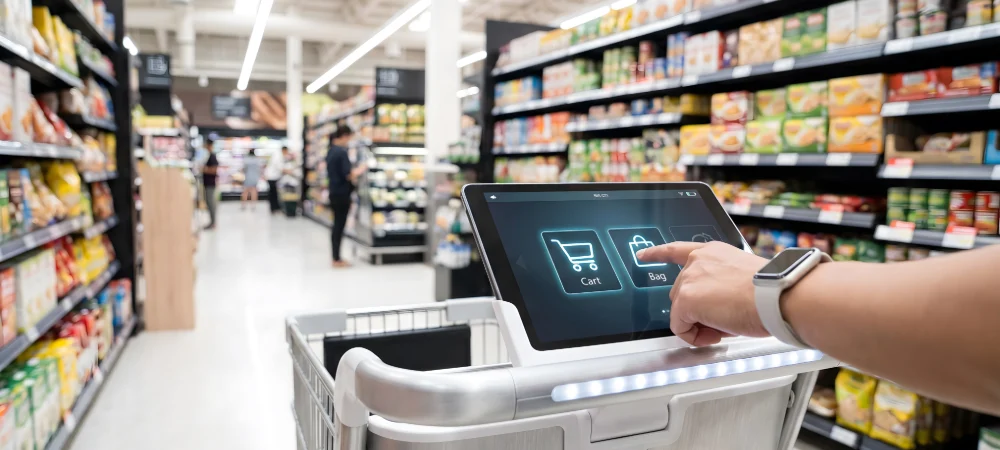
Today’s shoppers will do almost anything to avoid a queue. Increasingly, shopping journeys are moving from traditional checkouts to app-based experiences.
The UK’s major supermarket chains, Tesco, Sainsbury’s, Asda, Morrisons and Lidl, have grown with the times, offering Scan & Go or Scan as You Shop services to their everyday consumers.
So how does it work?
- Customers can pick up a handheld scanner or open the chosen supermarket app on their personal devices.
- Customers scan the barcode on items before putting them into their basket or bag.
- Items can be removed if no longer needed; this can be done in the app or on the handheld scanner.
- Payment can be carried out on the app.
- A digital or printed receipt is then provided, and customers can leave the store.
If this wasn’t simple enough, trial runs for checkout-free stores had previously been carried out across the UK, with the first being an Amazon Fresh store based in Ealing, West London.
Customers could scan their Amazon app, choose their groceries and leave the store without visiting a checkout. AI-based cameras and shelf sensors detected which items had been taken and then automatically charged the customer’s account, removing the need for any manual scanning.
Tesco GetGo, Sainsbury’s Smartshop Pick & Go and Aldi Shop & Go all followed in Amazon’s footsteps in trial runs but soon discovered that the high costs and operational demands proved harder to manage. Amazon Fresh later withdrew its checkout-free technology from its UK stores.
While this seems undoubtedly more convenient for customers, it also raises questions about how much personal data consumers are willing to give up in exchange for saving a few seconds at the checkout.
The widespread use of scan-and-go services and online shopping can reveal a significant amount of information about consumers. This enables supermarkets to offer personalised offers based on shopping habits, creating a detailed record.
Forget convenience, what would happen if a favourite retail shop became a victim of cybercrime?
Marks & Spencer (M&S) became the prime target in 2025, costing around £300 million to put right.
Customers were informed that stolen data could include:
- Names
- Addresses
- Dates of birth
- Contact numbers
- Online order histories
M&S confirmed there was no evidence that payment card details or passwords had been stolen. However, if a cyberattack of this scale were successful, it could result in widespread fraud, with customers potentially losing thousands of pounds.
Over the years, self-service has also raised many questions about what may be lost with reduced human interaction.
Kim Samuel, Founder of the Belonging Forum, a group dedicated to tackling social isolation, said: “The rapid rise of self-service has dehumanised our supermarkets and highstreets, with social consequences we’re only beginning to understand.”
The challenge for retailers now is understanding how to strike the right balance between digital convenience and the meaningful human interactions that continue to shape the shopping experience for all.

